lin-0054
3.3 Models and the factorization test
Let \(\mathcal C\) be the category in which the learning system is realized. A candidate system assigns a realized object to every formal object and a realized computation to every formal path.
A candidate model of \(\mathbb S\) in \(\mathcal C\) is a functor
It is a strict model when there is a functor
such that \(D=\overline Dq_{\mathcal D}\), and the images of the designated cones and cocones realize the universal properties specified by \(\mathcal L\) and \(\mathcal K\).
The commutativity component is therefore the lifting problem
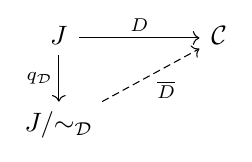
rather than an arithmetic expression such as \(g\circ f-f\circ g\). The latter expression becomes available only after choosing additive enrichment or an observation into a numerical space.
For a candidate model \(D\), define
The model is compositional exactly when \(\operatorname {Fact}_{\mathbb S}(D)\) is inhabited.
This set notation is economical, but the factorization problem can carry more structure: a category or space of fillers, a proof object, a sheaf of local fillers, or a derived obstruction object. LINCS leaves that choice to the realization.
Subject to Axiom 1.1, the base obstruction is the representing object
for admissible diagnostics of the factorization problem. Its distinguished trivial state corresponds exactly to an inhabited factorization problem.
The obstruction object is not assumed to be a vector. Depending on the application it may be a family of parallel-path witnesses, a cohomology class, a failure of effectivity, or a missing filler. A statistical hypothesis or test result is an observation of such an obstruction, not the obstruction itself.