lin-0155
12.1 The declared Kan diagram
Let \(X\) be a sequence or local data object, \(H\) a hidden representation, and \(Y\) the prediction object. A direct module
is compared with a structured route assembled from incidence transport, aggregation, and restriction:
The learning sketch declares
Kan extensions characterize universal ways to extend data along a functor [ Mac Lane , 1971 , Riehl , 2017 ] . In the computational realization, the incidence route is finite and parametrized; LINCS audits its agreement with the direct route rather than claiming that every learned approximation satisfies an exact universal property.
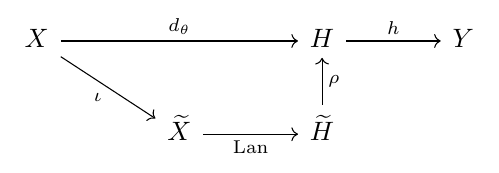
This is an ordinary diagram of maps in the computational category. At the functorial level, the universal comparison that licenses the \(\operatorname {Lan}\) route is a 2-cell of the form shown in Figure 7.1. The implemented finite route should not be promoted to such a cell by notation alone: naturality and the relevant universal property remain admission obligations. This is why LINCS observes the direct and structured routes instead of declaring them equal by design.