ifc-0001
Preface
Infinitesimal Creativity studies a question that lies beyond the optimization of a fixed model: how can an artificial reasoner construct, maintain, and extend a conceptual world?
“All things are made of atoms.”
—Richard Feynman, The Feynman Lectures on Physics
Feynman introduces the atomic hypothesis through a thought experiment. If a cataclysm destroyed scientific knowledge and only one statement could reach a future civilization, which statement would preserve the most information in the fewest words? His answer identifies atoms, their perpetual motion, and their attractive and repulsive interactions [ Feynman et al. , 1963 , Section 1–2 ] .
The force of the example is not brevity alone. The atomic hypothesis names objects, dynamics, and interaction laws from which an extraordinary range of phenomena can be reconstructed. It is a compact generative theory, not merely a compressed archive of observations. This book adopts that image as its governing aspiration: synthetically discover compositional structures whose models explain what is already known and make new deductions, predictions, and experiments possible.
The preceding books, Categories for AGI and Machine Learning from Enforcing Compositionality, developed the categorical language on which this book builds. They introduced diagrams, sketches, sheaves, tangent structure, typed obstructions, localization, repair, and admission. Chapter 0 provides a working primer sufficient to enter the present argument; the earlier books remain the route to broader motivation and fuller foundations. Our subject here is what happens when the declaration itself is no longer adequate.
No declaration, however, appears from nowhere. Before a reasoner can assimilate experience or accommodate a failing theory, it must acquire a provisional sketch of the domain. It may receive that sketch through explicit instruction, reconstruct it by watching competent behavior, or learn it as an apprentice whose teacher diagnoses and corrects its own attempts. Chapter 1 makes this initialization step explicit. The acquired sketch is not presumed complete or correct; it is the inspectable starting theory on which the later double-involution process operates.
Frontier models now prove difficult theorems, generate sophisticated programs, and search spaces that were previously inaccessible. Yet solving a problem inside number theory is not the same achievement as constructing number theory. A durable mathematical or scientific field introduces objects, operations, invariants, and laws that remain useful for problems not known when the concepts were proposed.
. Can a system recognize that its current conceptual language is inadequate, propose a more productive theory, transport what was previously known into that theory, and make the extension usable by other reasoners?
The phrase double involution names the book’s proposed organization of local change in two interacting directions. It does not mean that a creative theory arrives through two mechanical steps, nor that creativity is reduced to an ordinary gradient update. The first direction is assimilatory: observations and models vary while the current conceptual schema is retained. The second is proto-accommodative: local probes test how that schema itself might have to be reorganized. These terms adapt Piaget’s distinction between interpreting experience through an existing schema and modifying the schema when it no longer suffices [ Piaget , 1952 , 1985 ] .
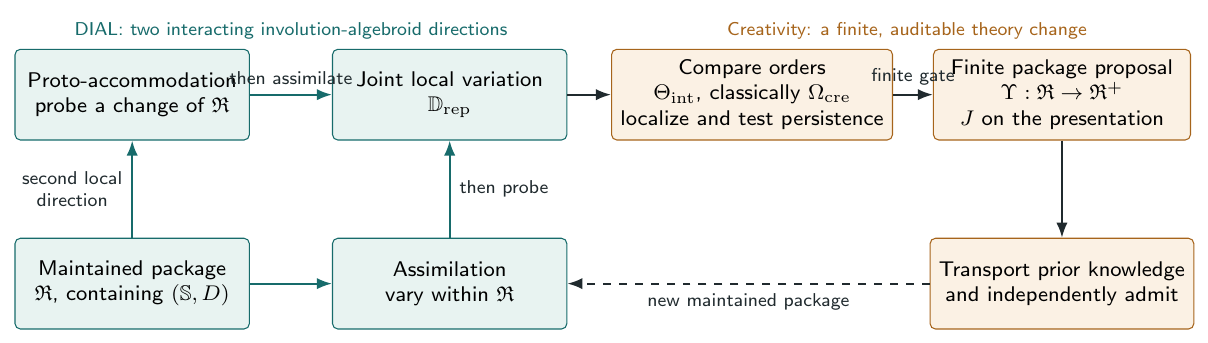
Mathematically, each direction will be represented by an involution-algebroid structure, an abstract infinitesimal geometry for admissible local variation. The double structure retains both directions and, crucially, their mixed interaction: does assimilating and then probing reorganization agree with probing reorganization and then assimilating? A failure of compatibility does not itself invent a theory. It localizes a conceptual frontier. Before a finite theory extension is proposed, the candidate local repair must persist under the registered probes, compose into a coherent finite realization, and survive less-disruptive explanations: parameter change, stronger search inside the current language, measurement or observer error, and other domain-appropriate controls. Only then may a new object, mechanism, invariant, or law be proposed, transported, and independently admitted. Chapter 2 develops this interpretation, and Chapters 3 and 4 supply its formal geometry.
For brevity, we call the proposed Double Involution ALgebroid architecture DIAL. In Figure 1, \(\mathbb D_{\mathrm{rep}}\) denotes the joint local variation, \(\Theta _{\mathrm{int}}\) its proposed internal interchange defect, and \(\Omega _{\mathrm{cre}}\) the corresponding classical cochain observer when a realization is supplied. Chapter 3 states the formal target and its unresolved bridge obligations.
The word double has a useful biological analogue. The importance of the DNA double helix lies not merely in having two strands, but in their structured complementarity. The pairing suggested how hereditary information could be copied: each strand could serve as a template for its partner [ Watson and Crick , 1953 ] . Fidelity preserves an organization across generations, while variation and recombination make altered organizations possible. Yet DNA does not create an organism by itself. Replication, expression, development, and selection require a larger cellular and environmental system.
DIAL makes an analogous architectural wager. Assimilation preserves and updates a maintained representational package; proto-accommodation explores how its generative organization might vary. Their double structure records not only the two directions but also their interdependence. But double involution alone is not creativity, just as the double helix alone is not life. Proposal machinery must construct a finite package change, and an admission environment must test whether that change remains coherent, transports prior knowledge, and survives new evidence. Only a change that extends the presentation or generative language supports the stronger claim of theory extension; many valuable repairs leave that language fixed. The central question of this book is whether this doubly connected learning architecture can repeatedly support creative theory construction across otherwise different AI applications.
Two historical episodes clarify both the ambition and its limits. The first comes from mathematics. Formulas for equations of degrees two, three, and four encouraged a centuries-long search for a corresponding formula for the general quintic. Ruffini and Abel established the obstruction to a general solution by radicals; Galois supplied a deeper reorganization. Instead of seeking one more expression in the old language, his work related solvability to the structure of permutations of roots—what later developed into Galois theory and modern group theory [ Brunk , n.d. ] . The achievement was not merely a more successful search through formulas. It changed the objects and invariants in which the problem could be stated.
This is a paradigmatic finite conceptual jump. A familiar problem generated pressure on an established representational language; a new structural language made the obstruction intelligible and remained useful far beyond the original problem. Nothing in this history, however, establishes that Galois reasoned by double involution. At most it supplies a demanding target for an artificial creativity architecture: can a system recognize that continued search in the current language is inadequate and construct a new algebraic theory with independently checkable consequences?
Darwin’s discovery reveals a complementary pattern. The diversity, geographical distribution, and fossil history of species demanded an account of change, but a scientifically adequate mechanism was missing. Darwin’s notebooks already treated species as mutable. His reading of Malthus in 1838 then supplied a transferable relational pattern: populations can grow faster than limited resources, producing a struggle in which not all individuals survive and reproduce. Applied to heritable biological variation, that pattern became a causal mechanism for natural selection [ Darwin Correspondence Project , 2015b , 2015a ] .
The episode combines two forms of theory construction. Darwin transported a schema from political economy into biology, but the result was not a literal copy of Malthus. Variation, inheritance, differential reproduction, and environmental pressure gave the transported pattern new biological meaning. The creative act was therefore both analogical and transformational: a cross-domain structural correspondence helped produce a new mechanism in the target theory.
Darwin’s geological work made a second idea equally important. Small effects need not have small historical consequences. Variation and differential reproduction can be locally slight while their repeated action over deep time produces divergence, adaptation, and extinction. The mechanism in nature is incremental even though the scientific concept that makes it intelligible is a finite reorganization of theory.
The eye made this distinction especially vivid. Paley’s earlier watchmaker argument contrasted a stone found on a heath with a watch whose coordinated parts appeared to require a designer [ Paley , 1802 ] . The eye seemed to present the biological version of the watch: what possible use could an incomplete intermediate organ have? Wilberforce’s 1860 review pressed related objections concerning missing transitional varieties and the absence of directly observable favorable variations [ Wilberforce , 1860 ] . Darwin addressed the difficulty directly. The relevant standard was not whether “half an eye” performs the work of a modern eye, but whether a sequence can exist from simple light-sensitive structures toward more complex ones, with every intermediate stage useful to its possessor. Slight inherited variations, accumulated under selection, could then explain apparent design without requiring the finished organ to appear in one leap [ Darwin , 1859 , Chapter VI ] .
These examples separate three notions that this book must not collapse. An infinitesimal process in the world can accumulate into a macroscopic effect. An investigator can use local variations, failed predictions, and cross-domain comparisons to probe the boundary of a theory. But a creative theory change is finite: it introduces a new object, mechanism, invariant, or law and then submits the enlarged theory to independent tests.
. Galois and Darwin are motivating examples, not retrospective validations of DIAL. The book does not claim that either thinker literally used double involution, nor that all creativity is infinitesimal. It asks whether typed local probes and their interactions can help an artificial system decide when to search beyond its current language and guide a finite, auditable theory extension.
With that distinction in view, the technical core uses two interacting infinitesimal geometries. Leung’s Weil theory first supplies tangent-category semantics for local probes, while involution algebroids connect one such tangent direction to classical Lie-algebroid geometry. This book proposes the corresponding double internalization for two interacting classes of repair: assimilatory repair inside a maintained theory and a proto-accommodative probe of how its organization might change. Mackenzie’s classical double Lie algebroids provide the concrete smooth model, including tangent, matched-pair, and cotangent Lie-bialgebroid forms of doubling [ Mackenzie , 2000a ] . Meinrenken–Pike’s distinct, bigraded cochain Weil algebra then supplies two differentials whose failure to super-commute localizes an incompatibility between the realized repair processes. This classical criterion motivates, but does not by itself establish, the proposed construction in every tangent category or smooth topos. A genuine creative jump remains a finite sketch extension whose transport and consequences must be admitted.
This proposed internal structure is the DIAL architecture introduced above. Its capitalization records the acronym rather than a new spelling of algebroid. DIAL is the concrete mathematical target of the book. Its proposed axioms and functorial semantics must recover the relevant classical double-Lie structure under stated realization hypotheses; its computational value must be established separately by comparisons showing whether two-direction diagnostics improve theory repair.
. Can DIAL turn two interacting modes of conceptual variation into an internal, transportable diagnostic whose realizations improve finite theory extension over single-direction tangent repair and equally resourced search?
We use synthetic creativity for this broader research program and infinitesimal creativity for its governing architecture. Its working maxim is:
Infinitesimal probes characterize the boundary of the current conceptual space. They do not imply that a creative leap is infinitesimal. The leap is an explicit theory transformation, and its value must be established by proof, simulation, prediction, experiment, or sustained reuse.
The book is organized around three questions. Part I asks what a creative theory change is and develops its categorical and differential language. Part II asks how that language becomes an algorithm whose target, proposal, and admission obligations remain typed. Part III asks what the resulting discipline reveals in mathematics, simulation, scientific literature, and visual generation—distinguishing structural repair from artistic theory extension—then separates the evidence established by those testbeds from the open domains and obligations that remain. Margaret Boden’s combinational, exploratory, and transformational modes cut across all three parts rather than assigning one mode to each application.
The trail map that follows gives conceptual, algorithmic, and testbed routes through this structure. It is deliberately navigational: the chapters retain the responsibility for defining their objects, evidence, and claim boundaries.
The ambition is deliberately larger than the results reported here. The purpose of this book is to turn a philosophical question into a sequence of typed, falsifiable challenge problems.