ifc-0002
A Trail Map of Infinitesimal Creativity
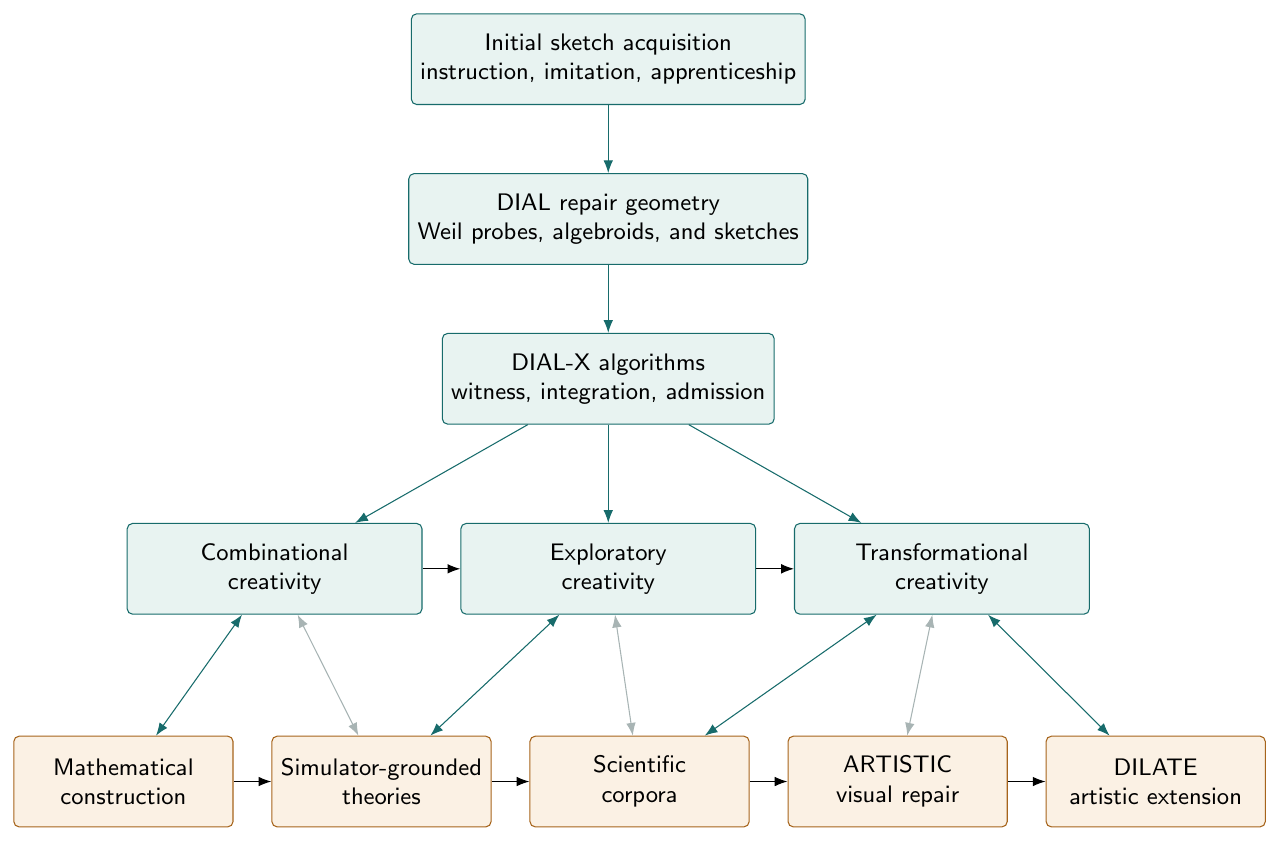
Readers new to categories, sketches, tangent categories, or Weil probes should begin with Chapter 0. The book can then be read along three routes.
The routes differ in entry point, not in destination. The conceptual route supplies the meanings of the objects, the algorithmic route turns those meanings into executable contracts, and the testbed route asks what evidence can warrant the resulting constructions. A reader may follow one route first, but Part II assumes the working vocabulary of the early foundational chapters, and Part III assumes the target-card discipline introduced in Chapter 10.
- Conceptual route.
Chapter 1 explains how instruction, imitation, and apprenticeship supply a provisional sketch. Chapter 2 states the theory-construction target; Chapters 3 and 4 develop its local geometry and executable skills; Chapter 5 specifies the finite theory artifact; and Chapter 6 locates that artifact in the wider creativity literature. Chapters 7–9 then distinguish the three creative modes using the common language established by those layers.
- Algorithmic route.
Chapter 10 turns DIAL into the DIAL-X family by declaring domain targets, side operations, mixed witnesses, creative mandates, finite-realization tests, less-disruptive controls, package comparisons, admission contracts, and persistent records. Chapter 11 develops Causal Learning with Infinitesimal Creativity (CLIC), Chapter 12 develops Optimizing Programs Through Infinitesimal Creativity (OPTIC), and Chapter 13 develops Reinforcement Learning with Infinitesimal Creativity (RELIC). Chapter 14 composes the three into Acquiring Generalizable Novel Theories with Infinitesimal Creativity (AGENTIC), a proposed meta-creative workflow architecture.
- Testbed route.
Chapters 15–17 use formal certificates, executable simulators, and source-bearing scientific corpora. Chapter 18 develops Acquiring Representational Theories through Infinitesimal Semantic Transport in Image Creation (ARTISTIC), a structural-assurance regime for generated images; Chapter 19 develops Double Involution Learning for Artistic Theory Extension (DILATE), an open-ended regime for reusable artistic operations. Four media thus yield five admission regimes. They are complementary rather than progressively weaker versions of one ground truth. Chapter 20 separates the evidence established by them from the broader program’s open obligations.
The routes are intentionally asymmetric in length. Chapters 7–9 isolate three conceptual distinctions; Chapters 11–14 isolate domain mechanisms and their interfaces; several testbed chapters preserve longer evidence ladders, including negative rungs, because the sequence of failed and repaired contracts is part of the result. Page count should therefore not be read as a ranking of maturity or importance. The evidential status stated inside each chapter—exact, estimated, constructed, admitted, rejected, or conjectural—is the relevant guide.
. Use the matrix as a discipline, not a taxonomy of model personalities. A single creative episode may combine registered structures, explore their consequences, encounter an obstruction, and then transform the theory.
The vertical and diagonal arrows matter. No testbed is assigned to only one mode. Every experiment is located by both a mode and a testbed.