lin-0056
3.5 A running equivariance sketch
Let a group element \(g\) act on inputs by \(a_g:X\to X\) and on outputs by \(b_g:Y\to Y\). A learned map \(F_\theta :X\to Y\) is declared equivariant by the square
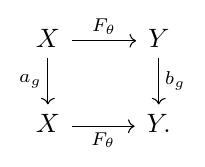
The indexing graph contains the two parallel paths
and \(\mathcal D\) identifies them. The base obstruction is the failure of the realized diagram to factor through this quotient.
If \(X\) and \(Y\) are normed spaces, one possible observation is
The vector \(E_{g,\theta }(x)\) and scalar \(\ell _{g,\theta }(x)\) are useful measurements, but neither defines equivariance. The declared square does.
Example 0.17 introduced this square using an image or language encoder. In the language setting, \(a_g\) must preserve or transform explicitly declared structure: it cannot be an arbitrary token permutation of a causal LLM. Depending on the task, \(b_g\) may reindex token-level states or act as the identity on an invariant decision. This choice belongs to the sketch and determines what an observed discrepancy means.
Let \(\mathcal V\) be a value-function space, \(P^\pi :\mathcal V\to \mathcal V\) the Markov expectation operator, and
the Bellman operator. A parameterized value family \(\widehat V:\Theta \to \mathcal V\) determines the parallel pair
Declaring this pair equal expresses Bellman consistency. Sampled TD and GTD objectives are scalar observations of its factorization obstruction; they do not replace the declaration [ Sutton , 1988 , Sutton et al. , 2008 , Sutton and Barto , 2018 ] .